AI Website Builder vs WordPress: Which Is Better for Long-Term Business Growth?
Here’s a question worth sitting with: when you picture your website three years from now, what does it look like?
Does it have a blog with 50+ articles driving organic traffic? A CRM integration feeding leads into your sales pipeline? Multiple team members updating service pages, uploading case studies, and publishing landing pages? If that’s the future you’re building toward, the platform you choose today will either support that vision or work against it.
The AI website builder vs WordPress debate gets a lot of attention, but most comparisons focus on the wrong things. They compare templates, pricing, and how fast you can launch. What they rarely cover is what happens after launch day. What happens when you need to update your pricing page, publish weekly blog content, connect your email marketing tool, or bring on a content writer? That’s where platform decisions actually matter.
This guide takes a different approach. Instead of comparing drag-and-drop editors and template libraries, it focuses on ownership, content management, scalability, and long-term growth. Building a website is easy. Managing and growing one for years is the real challenge.
The Short Answer: AI Builds Websites Fast, WordPress Builds Business Assets
AI website builders are genuinely good at what they do. Enter a few prompts, pick a style, and a polished website can be live within hours. For certain situations, that speed is exactly what’s needed, especially if you just need a simple online presence quickly.
WordPress works differently. Setup takes longer and there’s a learning curve, but what you get is a fully owned, deeply customizable platform that grows with your business. According to W3Techs (2024), WordPress powers approximately 43% of all websites on the internet. That kind of market share doesn’t happen by accident.
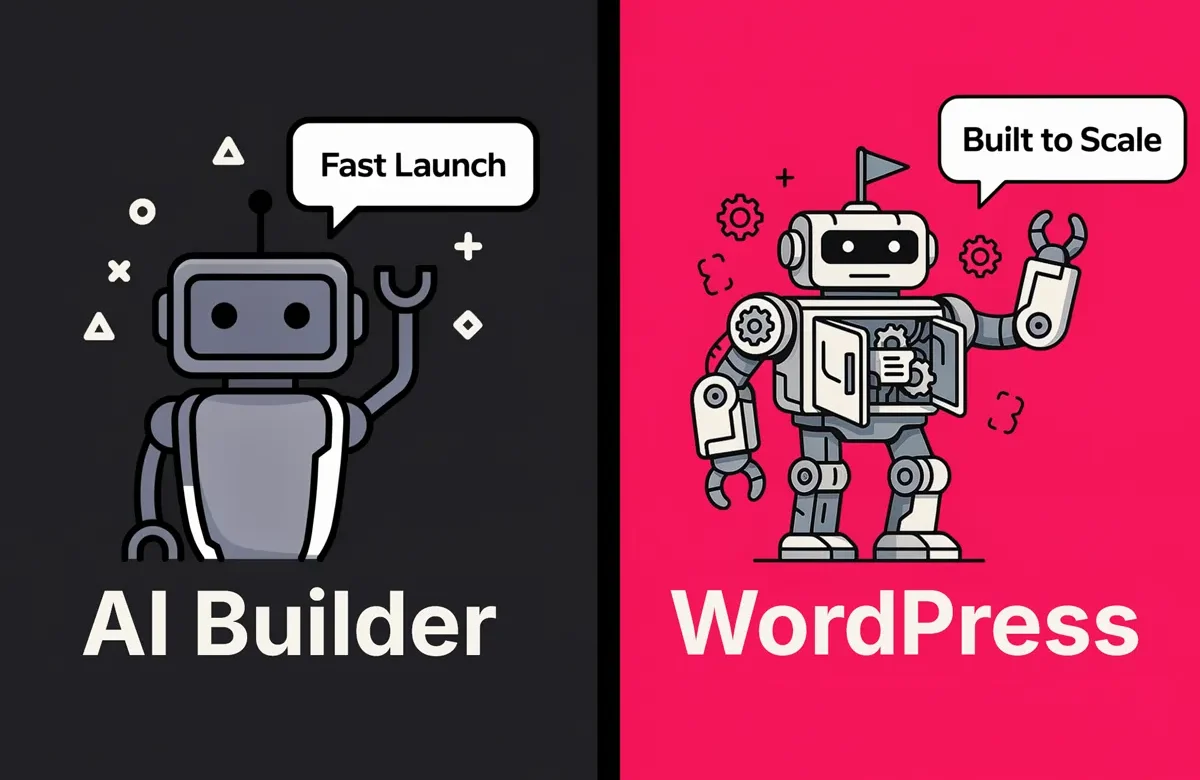
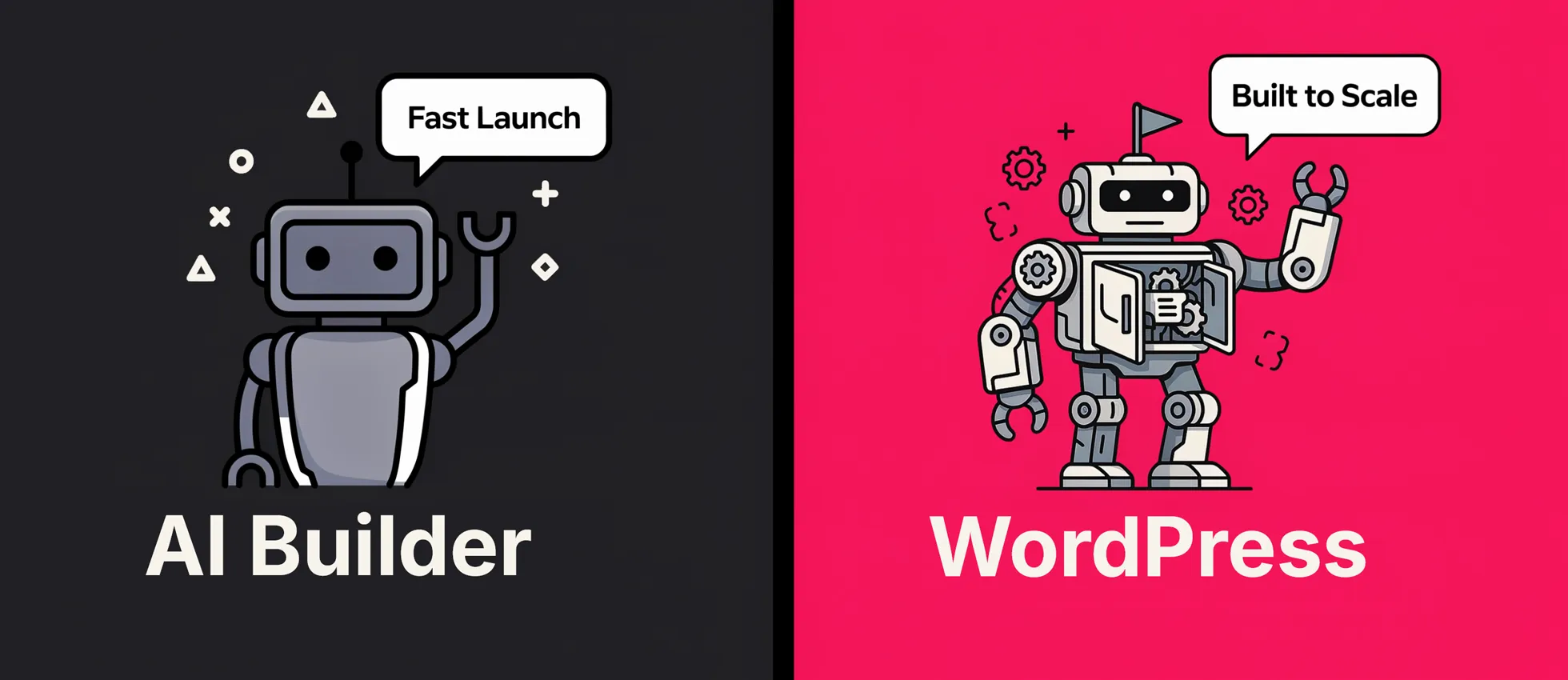
The core distinction: an AI website builder is built for launch day. WordPress is built for the years that follow.
AI Website Builder vs WordPress: Quick Comparison
Feature | AI Website Builder | WordPress |
Initial Setup | Very fast (hours) | Moderate (days to a week) |
Learning Curve | Low | Moderate |
Content Updates | Limited flexibility | Full control |
SEO Flexibility | Basic | Advanced |
Integrations | Limited | Extensive (50,000+ plugins) |
Ownership | Platform-dependent | Fully owned by you |
Scalability | Low to medium | High |
Multi-User Management | Limited | Built-in role management |
Custom Functionality | Restricted | Virtually unlimited |
Long-Term Flexibility | Low | High |
AI Website Builder vs WordPress: Category-by-Category Comparison
Ease of Use Winner: AI Website Builder
AI builders are designed for non-technical users and can generate a functioning website within hours. WordPress offers more flexibility but requires a greater time investment upfront.
SEO Winner: WordPress
While most AI website builders include basic SEO settings, WordPress provides significantly more control over site architecture, metadata, schema, internal linking, and content management.
Content Management Winner: WordPress
WordPress was built as a content management system. As content libraries grow, managing pages, posts, categories, and workflows becomes significantly easier.
Integrations Winner: WordPress
WordPress supports virtually any business tool through plugins and custom development.
Long-Term Scalability Winner: WordPress
As businesses grow, website requirements become more complex. WordPress offers far greater flexibility for expansion.
Speed to Launch Winner: AI Website Builder
AI builders are difficult to beat when speed is the primary objective.
A Website Is Not a Design Project. It’s a Business Asset.
Many business owners evaluate website platforms based on how quickly they can launch. The problem is that websites rarely stay static. Over time, they become marketing assets, lead generation tools, content hubs, and customer acquisition channels. The platform that works best on launch day isn’t always the platform that supports those goals three years later.
Why So Many Small Businesses Are Choosing AI Website Builders
It’s easy to see the appeal. For a small business owner juggling ten responsibilities, an AI website builder is a genuinely compelling option.
The pitch is hard to argue with: no coding, no hiring a developer, no waiting weeks for delivery. You describe your business, and the AI tool generates a clean, professional-looking website, copy, layout, and imagery included, in a fraction of the time it used to take.
Builders like Wix ADI, Squarespace, and newer AI-native platforms have made this even smoother. Prices are predictable. Hosting is bundled in. Support is easy to reach. And because most of these platforms include a page builder interface, making quick edits after launch feels intuitive.
Whether you’re considering Hostinger AI Website Builder, Durable, Wix ADI, 10Web, Lovable, Bolt.new, v0 by Vercel, Replit AI, or another AI-powered platform, the long-term considerations covered in this guide remain largely the same.
For a local service business that just needs a homepage, an about page, a contact form, and a list of services, an AI website builder can absolutely get the job done. The results look polished, the cost is manageable, and the whole process feels empowering.
The problems don’t show up on launch day. They show up twelve months later.
The Real Question Most Business Owners Aren’t Asking
Most small business owners approach website decisions with one question in mind: “How do I get a website up as quickly and cheaply as possible?”
That’s a fair question, but it’s the wrong first question.
The better question is: “What will I need this website to do in year two or year three?”
A business that launches with five pages and a contact form will look very different twelve months later. By then, the website might need a blog to compete on Google, landing pages for specific services, a CRM integration to capture and nurture leads, a booking system, an email marketing connection, multiple staff members editing content, and new service pages as the business evolves.
Most business owners don’t think about those needs on day one. But the platform they choose on day one determines how easily, or how painfully, those needs get met later.
The AI Website Trap: What Happens After the First 12 Months?
Consider a common scenario. A consultant launches a clean five-page website using an AI builder. The homepage looks sharp, the contact form works, and the whole thing was live within a day. It’s a real win at that stage.
Then the business starts growing. New challenges show up. This is where what could be called “the AI website trap” becomes visible.
The same challenge can apply whether the site was created with a traditional AI website builder like Wix ADI or Durable, or a newer AI-powered development platform such as Lovable, Bolt.new, v0, or Replit AI.
Problem #1: Content Updates Become Harder Over Time
At launch, updating an AI-generated website feels simple. But as the business evolves (new services added, team members joined, pricing restructured, case studies ready to publish) the limits of AI content management become more apparent.
Many AI website builders restrict how deeply you can customize page structures or add new content types. What felt flexible on day one can feel rigid by month six. Adding a blog section, restructuring navigation, or creating a new service page often means working around the platform instead of with it. The customization that seemed like enough early on starts to feel limiting.
WordPress, by contrast, is built around content management. That’s what a CMS (content management system) actually means: a platform designed for ongoing content updates, not just a one-time launch. With WordPress, content workflows become a strength instead of a bottleneck.
Problem #2: SEO Growth Requires More Than a Homepage
Ranking on Google isn’t a one-time event. Sustained SEO growth depends on publishing consistent blog content, building internal linking structures, creating targeted landing pages, optimizing metadata across dozens of URLs, and managing content architecture at scale.
AI website builders typically offer basic SEO tools: a title field, a meta description box, maybe an alt text option. That’s enough for a brochure website. For a small business investing in search traffic, which most growing businesses eventually do, it falls short quickly.
WordPress supports advanced SEO through plugins like Yoast SEO and Rank Math. Each one gives you granular control over technical SEO settings, schema markup, XML sitemaps, breadcrumbs, and content readability scoring. The gap in SEO flexibility between the two platforms is significant, and it compounds over time.
Problem #3: Multiple People Need Access to the Website
Here’s something that doesn’t come up on day one but becomes important as the business grows: who else needs to edit the website?
A marketing manager needs to update a landing page. A content writer needs to publish a blog post. A VA needs to change office hours. An agency needs access to run a campaign.
WordPress has a built-in user role system, including administrator, editor, author, contributor, and subscriber, that lets different people have different levels of access. This is standard on any well-managed WordPress site. Many AI website builders offer limited or rigid user management, which creates real friction as teams expand.
Problem #4: Security, Maintenance, and Ownership Questions Start Appearing
Who owns your website? It sounds like a simple question, but with some AI website builders, the answer is more complicated than expected.
If a platform shuts down, changes its pricing model, or discontinues a tier, what happens to the website? Can the content be exported? Can the domain be transferred? These are ownership questions that matter a lot over a three-to-five-year business horizon.
WordPress websites are self-hosted, meaning the files, database, and content live on hosting infrastructure the business owner controls. The website is an asset, not a subscription. With some AI-generated website platforms, the website works more like a rental.
On maintenance, WordPress does need regular updates to core software, plugins, and themes. This is a real responsibility. Managed WordPress hosting providers, such as WP Engine, Kinsta, or Flywheel, handle much of this automatically, which cuts down the burden significantly.
Problem #5: Integrations and Scalability Become Business Requirements
A growing business will eventually need to connect its website to other tools: a CRM like HubSpot or Salesforce, an email marketing platform like Mailchimp or ActiveCampaign, a booking system, a membership portal, an ecommerce layer, or a marketing automation stack.
AI website scalability is limited. Most AI-native builders support a curated set of integrations, and stepping outside those boundaries can be difficult or impossible without rebuilding on a different platform entirely.
WordPress supports over 59,000 plugins, according to the official WordPress plugin directory, covering nearly every integration a business might need. Whether it’s WooCommerce for ecommerce, MemberPress for memberships, or any number of CRM connectors, the ecosystem is vast. There’s a plugin for almost everything, and when there isn’t, a developer can build one.
Why WordPress Continues to Power a Large Portion of the Web
The numbers are hard to ignore. WordPress powers approximately 41.9% of all websites globally, including major media outlets, large ecommerce operations, and millions of small businesses. That market penetration reflects real-world durability.
What makes a WordPress site a long-term asset for business owners comes down to a few core strengths:
- Full content ownership. The website and all its data belong entirely to the business.
- SEO infrastructure. Deep control over technical SEO, content architecture, and metadata.
- Plugin ecosystem. 59,000+ plugins covering almost any functionality you’d need.
- Multi-user access. Granular role management for teams, agencies, and contractors.
- Customization. From themes to custom-built features, the flexibility is nearly unlimited.
- Portability. The website can be migrated between hosts without losing anything.
- Community and longevity. Backed by Automattic and a global open-source community.
None of this means WordPress is the right choice for every situation. But for businesses that plan to invest in SEO, content marketing, integrations, and team collaboration, WordPress offers a depth that AI website builders currently can’t match.
When an AI Website Builder Makes Sense
AI website builders do have genuine, legitimate use cases. An AI tool is a smart choice when:
- The project is temporary, like an event website, a promotional campaign, or a seasonal offering
- The business is testing an idea and validating a concept before investing in a full build
- You just need a simple one-page presence, like a personal brand, a portfolio, or a basic landing page
- Speed is the priority and you need something live within 24 hours
- The business is very early-stage, run by a solo freelancer who just needs a basic online presence and isn’t yet investing in SEO or content marketing
For these situations, an AI website builder provides real value. It’s fast, affordable, and professional-looking, and it does exactly what it promises.
The risk arises when a business planning to grow chooses an AI builder for the same reasons a temporary project would, without weighing the limitations that emerge at scale.
When WordPress Is the Better Long-Term Investment
WordPress becomes the clearer choice when the business has, or plans to develop, any of the following:
- A content marketing or blog strategy
- Search engine optimization as a growth channel
- Integration with CRM, email marketing, or automation tools
- Multiple team members managing website content
- Ecommerce, membership, or booking functionality
- A need to own and control the website as a business asset
- Plans to scale services, locations, or offerings over time
For service businesses, consultants, coaches, local businesses, agencies, and startup founders building for long-term growth, WordPress means investing in a platform that scales alongside the business instead of constraining it.
How to Decide: A Simple Framework for Small Business Owners
Choosing between an AI website builder and WordPress doesn’t have to be complicated. Work through these four questions:
- What does this website need to do in year three? If the answer involves content management, SEO, integrations, or team collaboration, lean toward WordPress.
- Who else will need to update the website? If the answer is anyone beyond the founder, multi-user management and role control matter. WordPress handles this natively.
- Does the business plan to invest in SEO or content marketing? If yes, you’ll need the SEO flexibility and blog infrastructure that WordPress provides. Most AI website builders still offer significantly less SEO flexibility than WordPress.
- How important is platform ownership? If the website is a long-term business asset and not a placeholder, owning the infrastructure matters. WordPress provides that; many AI builders don’t.
If three or more answers point toward growth, integration, and ownership, WordPress is likely the better platform. If the need is fast, simple, and temporary, an AI builder delivers.
Final Verdict: Don’t Choose Based on How Fast a Website Is Built
TL;DR: AI website builders are fast, affordable, and beginner-friendly, which makes them a good fit for getting online quickly. WordPress takes more setup but gives you far greater control over content, SEO, integrations, and scalability. For long-term business growth, WordPress is usually the stronger investment. The right choice depends on where your business is heading, not just where it is today.
The fastest website to build is not always the best website for business growth. That’s the core idea worth carrying forward.
AI website builders have earned their place in the market. For the right use case, they’re excellent tools. But many small business owners choose them based on launch-day criteria, like speed, simplicity, and cost, without fully thinking through the next three years of content updates, SEO investment, team growth, and platform scalability.
WordPress requires more upfront effort. There’s a learning curve, hosting to set up, themes to evaluate, and plugins to configure. But that investment produces a website the business truly owns, one that can be expanded, integrated, optimized, and handed between team members without hitting walls.
Build for where the business is going, not just where it is today. The platform that supports that journey is the better long-term investment.
Frequently Asked Questions
What is the main difference between an AI website builder and WordPress? AI website builders use artificial intelligence to generate websites quickly, with minimal technical input. WordPress is an open-source CMS that requires more setup but offers far greater control over content, SEO, integrations, and ownership. AI builders are built for speed; WordPress is built for long-term management and growth.
Can an AI website builder rank on Google? AI-generated websites can rank on Google for basic searches, but they typically lack the SEO infrastructure needed for sustained organic growth. Advanced SEO tasks, such as managing content architecture, internal linking, schema markup, and technical optimization across multiple pages, are significantly easier to handle on a WordPress site.
Is WordPress too difficult for small business owners without technical skills? WordPress has a learning curve, but it’s manageable, especially with modern page builder tools like Elementor or Divi and managed WordPress hosting that handles updates, backups, and security. Many small business owners run WordPress websites on their own or with occasional support from a freelancer or developer.
What are the biggest limitations of AI website builders for growing businesses? The most significant limitations include restricted content management, limited SEO flexibility, fewer third-party integrations, constrained multi-user access, platform lock-in, and reduced ownership of the website as an asset. Customization options also tend to hit a ceiling quickly as business needs evolve.
Can I migrate from an AI website builder to WordPress later? Technically, yes, but it’s rarely straightforward. Most AI website builders don’t offer clean export options, so migrating to WordPress often means rebuilding the website from scratch. Choosing the right platform earlier avoids this cost and disruption.
How much does WordPress cost compared to an AI website builder? AI website builders typically charge $10 to $35 a month on subscription plans, with hosting included. WordPress itself is free, but hosting costs $5 to $50 a month depending on the provider and plan. Premium WordPress themes and plugins add additional costs. Over two to three years, the total cost of ownership is broadly comparable, though WordPress offers significantly more capability at higher price points.
Which is better for a local service business, an AI website builder or WordPress? For a local service business that plans to invest in local SEO, publish service-specific landing pages, and grow its content over time, WordPress is the stronger long-term choice. For a business that just needs a basic online presence with no plans for content growth, an AI website builder is a practical starting point.
Is WordPress an AI website builder? No. WordPress itself is not an AI website builder, although many WordPress plugins now include AI-powered features for content generation, design assistance, and automation. WordPress remains a traditional CMS that gives users full control over their website.