Your Creative Isn’t Tired. Your Process Is.

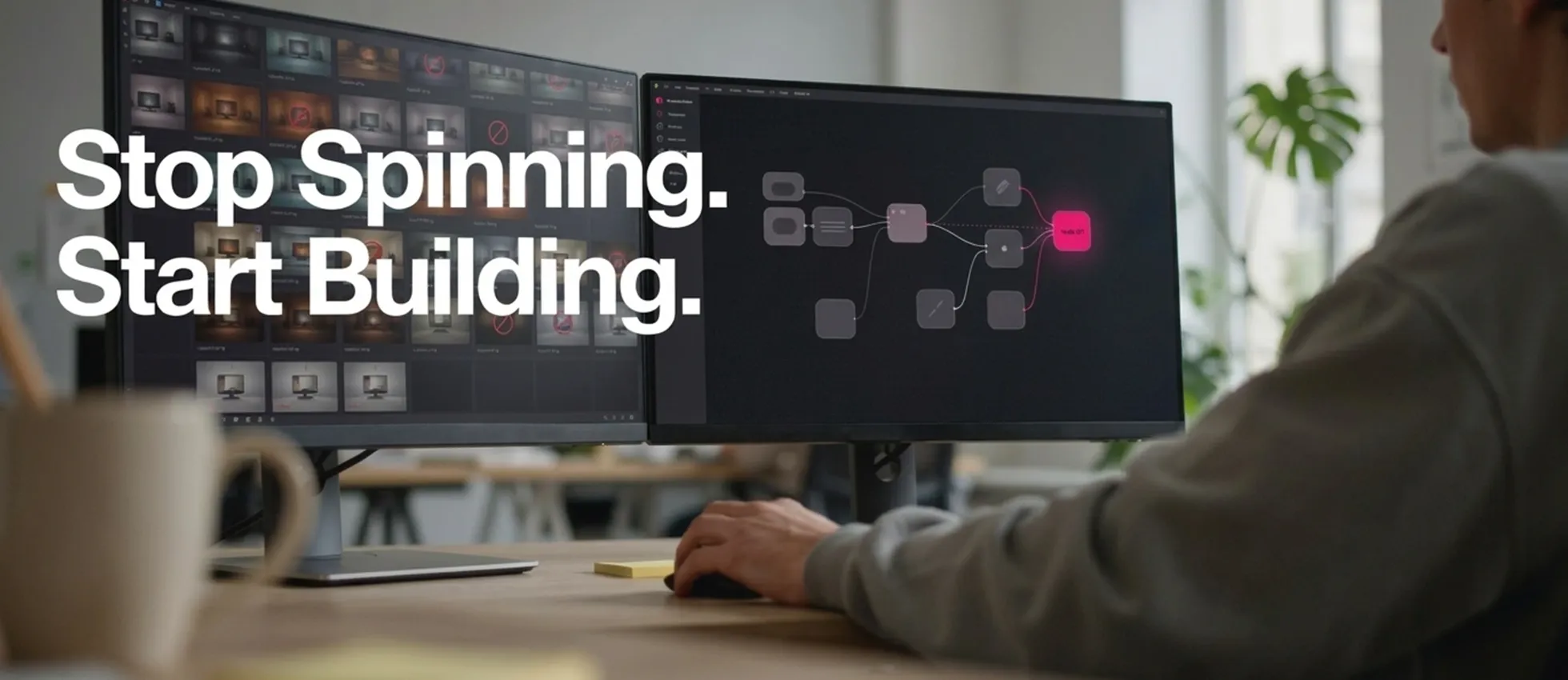
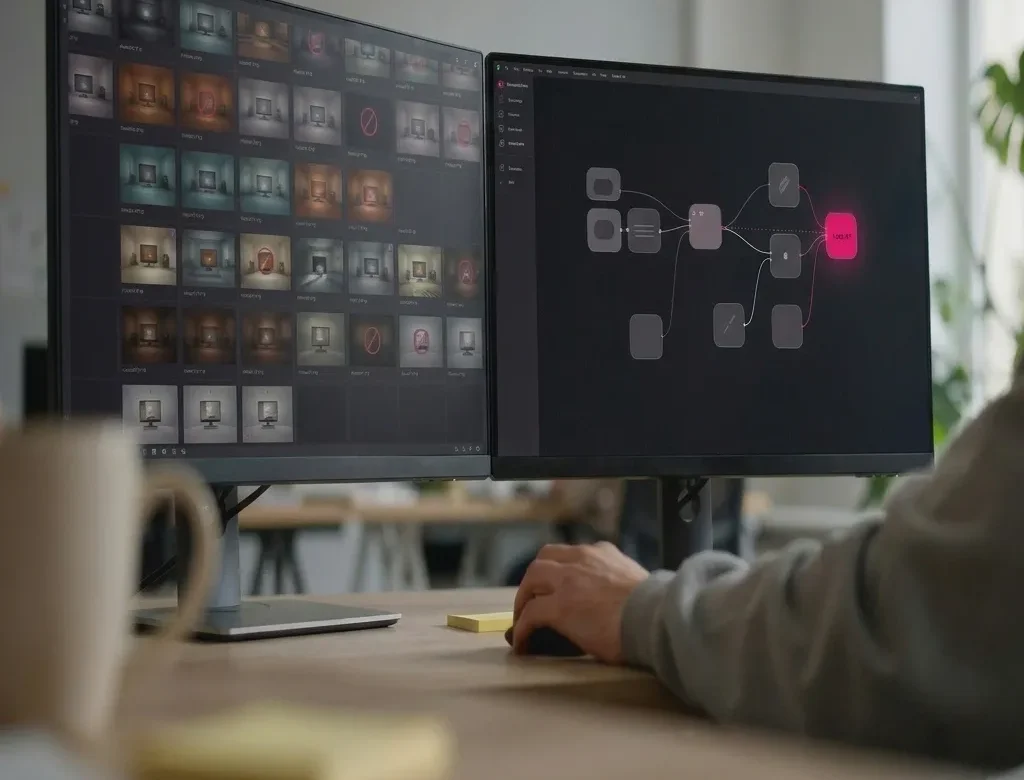
Image of a dual screen, with images in the screen with a man working at a desk

shares

Your Creative Isn’t Tired. Your Process Is.

If your AI creative pipeline feels inconsistent, off-brand, or impossible to scale, the problem is almost never the tool or your team’s talent. It’s the process: most teams use AI one prompt at a time, re-deciding the same brand choices on every image. The fix is to turn those decisions into a repeatable creative pipeline that locks your look, tests ideas side by side, bakes in the edits, and lets anyone on the team produce on-brand assets.

We call the prompt-at-a-time habit Prompt Roulette. Here’s why it costs you the most right now, what Figma’s new tool Weave changes about creative production, and the four-node pipeline we’re building at Seventy Seven Collective.

What is Prompt Roulette, and why does it waste so much time?

Somewhere right now, a marketing coordinator is typing “make it pop” into an AI image generator for the thirty-eighth time, and the AI is responding with something that is technically related to the request.
I’ve been that person. I once spent an entire afternoon rerolling a single hero image like I was parked at a Vegas slot machine, convinced the next pull was the jackpot. The jackpot turned out to be realizing I’d burned four hours on one picture of a coffee mug.
That’s Prompt Roulette. You spin, you hope, you pick the least weird result, and next week you start from zero again. See if any of these sound familiar:
  • Every ad in your account looks like it came from a different brand that happens to share your logo.
  • The one person who knows the magic prompts goes on vacation, and the magic goes with them.
  • You need forty variations for holiday and another forty for January, and the team is running on cold brew and spite.
The uncomfortable truth is that AI made it faster to create one thing. It did not make it any easier to create the right thing forty times in a row.

Why does creative matter more than ever in paid media?

The ad platforms have taken over most of the targeting work. You feed the algorithm, and the algorithm finds the people. That leaves creative as the biggest lever you still control inside your Traffic Machine.

And the algorithm is hungry. It wants volume and variety, and it wants both to stay consistently on-brand. That combination is exactly what Prompt Roulette is worst at, which is why the cost shows up hardest in Q4 and Q1, when you need the most variations in the least time.


Prompts are one-time decisions. Every time you retype one, you’re re-deciding things you already figured out.

Your colors, your lighting, the way your product sits in the frame: those choices were made the day your best ad went live. Prompt Roulette makes you make them again, every single time, and usually a little worse.

What is Figma Weave, and how is it different from an image generator?

Figma bought a company called Weavy about a year ago and turned it into Weave. The big idea is a node-based canvas, which sounds like engineering jargon until you think about it like cooking.

Most people use AI like a cook who makes dinner from memory every night. Some nights it’s great. Some nights the smoke alarm is the only one clapping. Weave lets you write the recipe down. You connect steps together: your brand references go in here, the image model runs here, an editing step cleans it up here, and a video model animates it at the end.

Two details matter most for marketers:
  1. Multiple models on one canvas. Weave pulls models from Google, OpenAI, Kling, Runway, Luma and others into one place, so you can run the same brief through different models and compare the results side by side instead of juggling six subscriptions and a spreadsheet of passwords.
  2. A simplified version anyone can run. Once the pipeline is built, you can share a stripped-down interface where a teammate drops in a product photo and a brief, and the assets come out the other side. They don’t need to understand the whole machine to operate it.
That second one is what we’re putting through its paces at 77co right now. Our current setup uses an agent to research the industry and write the initial prompts, while a creative owns the mood boards, the creative direction, and the expected style outputs. Robots handle research, humans own creativity and decisions, and both work on the output together. Your best creative thinking stops living in one person’s head and starts living in a system.

How do you build a creative pipeline? The four nodes

Don’t try to build all four this week. Pick one, maybe two.

Node 1: Lock the Look

This is the part of the pipeline that never changes: brand references, color palette, and visual rules. Consistency is what makes forty ads feel like one brand instead of forty strangers.

Do this:
gather five to ten of your best on-brand images as reference inputs. Write your color rules as exact hex codes instead of “kind of a warm blue.” Decide your no-go list (no stock-photo handshakes, no glowing AI halos), and save it all as the first node so every output starts there.

Node 2: Branch the Bets

This is where you test multiple creative directions at once instead of one at a time. The cheapest time to kill a bad idea is before you’ve spent media dollars on it.

Do this: run one brief through two or three different models and compare them side by side. Branch one concept into three moods or angles, then pick winners with your team in the same canvas instead of over a 47-message email thread.

Node 3: Bake In the Edits

These are the cleanup steps you always do by hand, built directly into the pipeline. The edit you do manually forty times is the edit that gets skipped on version twenty-nine.

Do this: add steps for resizing to every placement you run, upscaling, background cleanup, and image-to-video for your motion versions, so every output comes out finished instead of 80 percent done.

Node 4: Hand Over the Keys

This means turning the pipeline into a simple interface the rest of your team can run. A system that only the builder can operate is just a fancier version of the person who went on vacation.

Do this:
share the simplified version with your campaign team and define exactly what inputs they provide (a product photo and a one-line brief, that’s it). Keep a human approval step before anything goes live, because the machine makes it and a person still owns it.

What are the limits of AI creative pipelines?

A fair word before you rebuild your whole creative department. Weave runs on credits, so production has a real cost. It won’t fix a weak offer, because no pipeline can make people want something they don’t want. And you should still disclose AI-generated creative wherever the platforms require it.
It’s a production engine, and an engine still needs someone who knows where the car is going. That’s why strategy sits upstream of the pipeline in every growth machine we build, and why the pipeline only pays off when the page it sends traffic to can convert.

Before you build anything, do this one thing

Pull up your best-performing ad of 2026 and write down the five decisions that made it work: the background, the angle, the color, the text treatment, whatever it was.

That list is the first draft of your recipe, and it’s Node 1 waiting to happen. If you want a default plan, write those five decisions down this week and build Node 1 before the end of the month.

A slot machine pays out sometimes. A machine you built pays out on schedule.

FAQ

What is Prompt Roulette?

Prompt Roulette is the habit of generating AI creative one prompt at a time, rerolling until something looks acceptable, and starting from scratch the next time. It produces inconsistent, off-brand assets and depends on whoever knows the “magic” prompts.

What is Figma Weave?
Figma Weave is a node-based AI creative canvas, built from Figma’s acquisition of Weavy, that connects brand references, AI models, editing steps, and video generation into a reusable workflow. It pulls models from Google, OpenAI, Kling, Runway, Luma and others into one place.

How is a creative pipeline different from a prompt library?
A prompt library stores words you still have to rerun and fix by hand. A pipeline stores the whole process, including brand rules, model choices, and cleanup steps, so every output starts from the same decisions and comes out finished.

Do you need to disclose AI-generated ad creative?
Yes, wherever the ad platforms require it. A pipeline should also keep a human approval step before anything goes live.

Want to know where your machine is leaking?

Great creative only pays off if people can find you and the page you send them to converts. Start with a free AI Visibility Snapshot to see how your brand shows up across ChatGPT, Gemini, Copilot, and Perplexity, ranked against up to three competitors.
Or skip straight to a conversation
Agencies sell services. We build growth machines.